Where the Indian Ocean narrows to wind and basalt
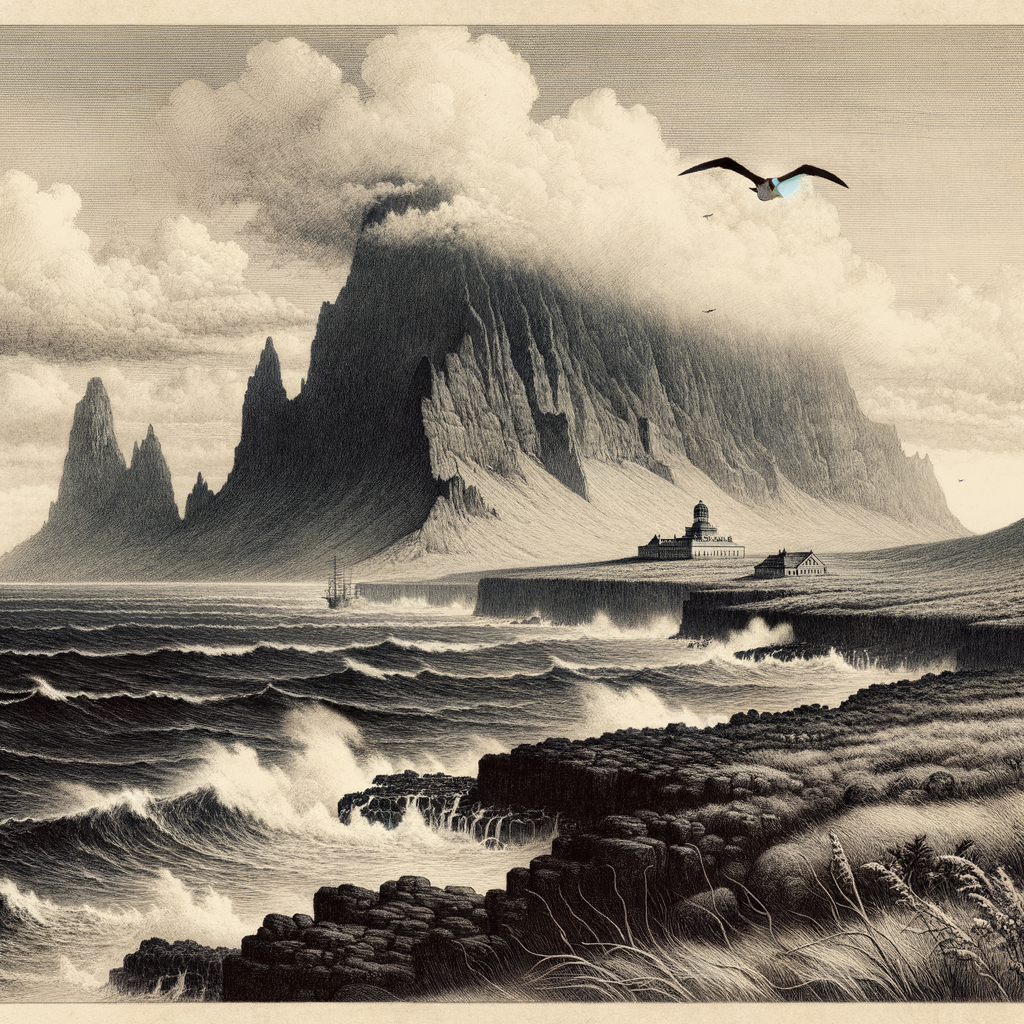
Far from the sea lanes most maps teach us to notice, Amsterdam Island rises alone from the southern Indian Ocean, a dark volcanic outpost between Africa, Australia, and Antarctica. It belongs administratively to the French Southern and Antarctic Lands, yet it feels less like a possession than a survival: a summit of old lava, about 55 square kilometers in area, ringed by cliffs, battered by surf, and softened in places by slopes of grass and low vegetation that seem almost pastoral until the weather turns and the isolation becomes impossible to ignore. There is no town, no harbor of consequence, no civilian life. What exists instead is exposure—to wind, to distance, to the long memory of the ocean.
The island stands on a volcanic edifice that rises steeply from the seafloor. Its highest point, Mont de la Dives, reaches roughly 881 meters, enough to catch cloud and break the light into sudden shifts of brilliance and shadow. The coast is severe in many places, but the northeastern side offers the rare concession of a landing area at Martin-de-Viviès, the scientific station that keeps a small, rotating human presence here. Elsewhere, the land gives way abruptly to the sea. The sensation is of a place unfinished by comfort: a remote cone weathered by salt, rain, and restless air, where every contour reminds you how far you are from any continental reassurance.
A name from ships, a history of brief and difficult arrivals
European knowledge of the island enters the record in 1522, when the Spanish navigator Juan Sebastián Elcano, completing the first circumnavigation after Magellan’s death, reported it during the voyage of the Victoria. The name by which it is known came later, attached by Dutch mariners in the age when the Indian Ocean was measured by risk, latitude, and endurance. For centuries it remained what many remote islands were to passing ships: a landmark, a possible source of fresh provisions, a dangerous hope.
Those who did come ashore rarely stayed long. Sealers and other mariners visited in the eighteenth and nineteenth centuries, leaving behind the familiar marks of exploitation that scar so many subantarctic islands. Introduced cattle, set loose in the nineteenth century, transformed part of the landscape for generations, trampling and grazing native vegetation. Attempts at settlement were fragile and short-lived. France formally took possession in 1843, though practical occupation remained intermittent. The real continuity of human presence belongs to the twentieth century, when meteorological and geophysical work made the island valuable not as a colony or port, but as an observing station at the edge of the Roaring Forties.
That station, established in its modern form after the Second World War, is now the island’s heartbeat: a small scientific community measuring atmosphere, climate, and earth processes in one of the most isolated inhabited sites on the planet. Even this presence feels provisional. Supplies arrive by ship. Access depends on sea and weather. Nothing about life here suggests permanence in the ordinary sense; the place permits occupation, but never domestic ease.
The wounded and recovering living world
What gives the island much of its modern significance is not simply its solitude, but the delicacy of what survives there. It is part of a remote ecological province that once held immense seabird colonies, and despite centuries of disturbance, the island still shelters species found nowhere else. Most famous among them is the Amsterdam albatross, Diomedea amsterdamensis, one of the world’s rarest albatrosses, breeding only here. A bird of extraordinary wingspan and oceanic range, it returns to a single island to nest—an evolutionary wager on isolation that became perilous once humans and introduced animals altered the habitat.
The damage was profound. Grazing cattle degraded the uplands and contributed to the shrinking of native vegetation, including the remarkable forest of Phylica arborea, a tree once much more widespread on the island. Fire compounded the pressure. Introduced predators and disease added further strain to seabirds already tied to limited breeding ground. Yet Amsterdam Island is not only a story of loss. It is also one of restoration carried out with unusual seriousness. Conservation programs removed feral cattle in the twenty-first century, protected remaining habitat, and aimed to restore native plant communities. The island is now recognized internationally for its ecological importance, and together with neighboring territories forms part of a UNESCO World Heritage listing for the French Austral Lands and Seas.
Even so, the island’s scientific value has sometimes come with unease. In recent decades, avian cholera caused by Pasteurella multocida has devastated some seabird populations, especially Indian yellow-nosed albatrosses and other nesting birds. On a mainland, such a disease event would be one conservation crisis among many. On an island like this, where entire populations can be concentrated in one place, it becomes existential. Isolation protects, and isolation magnifies catastrophe.
A small station in a very large emptiness
There are remote islands that invite fantasy, and there are remote islands that resist it by the plain force of their reality. This is the second kind. Its atmosphere comes not from legend so much as from documented remoteness: months of ocean in every direction, hard landings, cloud banks dragging over volcanic slopes, birds that cross hemispheres only to return to one exposed ridge. The island has been known to navigators for five centuries, yet it still occupies the imagination less as a destination than as a limit case—a place that tests what human presence can mean when almost everything familiar has been stripped away.
Seen in that light, the scientific station does not diminish the mystery; it sharpens it. Instruments click and record. Weather balloons rise. Researchers count nests, monitor disease, trace atmospheric chemistry. Meanwhile the sea keeps striking the cliffs, and the island remains what it has long been: a singular piece of ground held in a vast field of water, important precisely because it is so lonely. In an age that has mapped nearly everything, there are still a few places whose power lies in their refusal to feel domesticated. This is one of them.