About
The Crozet Islands are a group of five islands located in the southern Indian Ocean, part of the French Southern and Antarctic Lands, an Overseas territory of France. The islands were first discovered by the French navigator Captain Bouvet de Lozier in 1772, who named them after his ship, the “Crozet.” The islands were later visited by a number of explorers and sealers, but they remained uninhabited until the late 19th century.
In 1843, a French expedition led by Captain Jules Dumont d’Urville established a base on Île de la Possession, the largest of the Crozet Islands. The base was used as a supply station for French ships exploring the Antarctic region, and it also served as a base for scientific research. The island’s first permanent settlement, Port-aux-Français, was established in the 1850s.
During the late 19th and early 20th centuries, the Crozet Islands were exploited for their mineral resources, particularly guano (seabird excrement) and seals. The islands became a source of phosphates, which were used as fertilizers in agriculture. The exploitation of the islands led to the introduction of invasive species and the destruction of the local ecosystem.
In the 1950s, France established a permanent research station on Île de la Possession, called Alfred Faure station, which focused on meteorology, geomagnetism, and biology. The station was closed in the 1970s and was replaced by a new station, Jean-Baptiste Charcot, which operates till today. Today, the Crozet Islands are home to a variety of unique and endangered species, including seabirds, seals, and penguins. The islands are also an important site for scientific research, including studies of meteorology, geology, and the impacts of climate change.
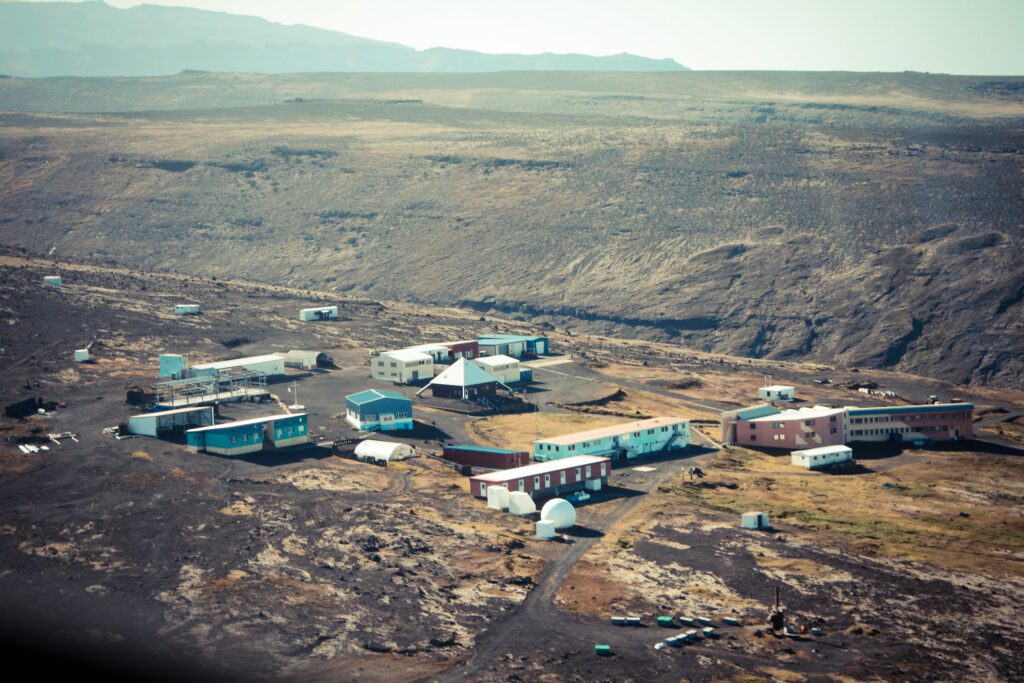
Alfred Faure station
Credit: The Official CTBTO Photostream
The Crozet Islands are also of importance as a wildlife sanctuary. The islands are home to a large population of king penguins and albatrosses. In addition to that, the islands are also the breeding ground for a number of other seabirds and marine mammals such as elephant seals and fur seals. The French government has established a nature reserve and a protected area on the islands to conserve the unique ecosystem and biodiversity of the islands.