A dot that has altered fate
In the western Pacific, between the better-known names of Micronesia, there is a scrap of coral so small that many maps barely dignify it with a mark. Pikelot lies in the Caroline Islands, part of the Federated States of Micronesia, and belongs to the state of Yap. It is uninhabited, low, narrow, and easy to miss: a sandy islet perched on a reef, with scrub and trees rising only modestly above the ocean. Yet this slight piece of land has repeatedly entered human lives at moments of extremity, when open water has become too large, too empty, and too absolute.
Its dimensions are modest even by atoll standards. The island is only a few hundred meters long, ringed by reef and exposed to the full force of weather and swell. There is no settlement, no harbor, no fresh stream. What it offers instead is the most basic bargain an ocean can make with a castaway or a seabird: dry ground. Coconut palms and other hardy vegetation manage to root in the coral-derived soil, and seabirds use the place as a nesting site. Around it, the sea shifts abruptly from reef shallows to the wider blue of a remote oceanic province where distances are measured less in kilometers than in endurance.
Known first by navigators, then by those in trouble
Like many small islands in Micronesia, this one was long known within regional voyaging worlds before it settled into the record of European charting. The Carolines were crossed by skilled navigators for centuries, and even tiny landfalls mattered in a sea where memory, stars, swell patterns, and bird flight formed a practical science. A place does not have to be large to be important; it only has to exist in the right emptiness.
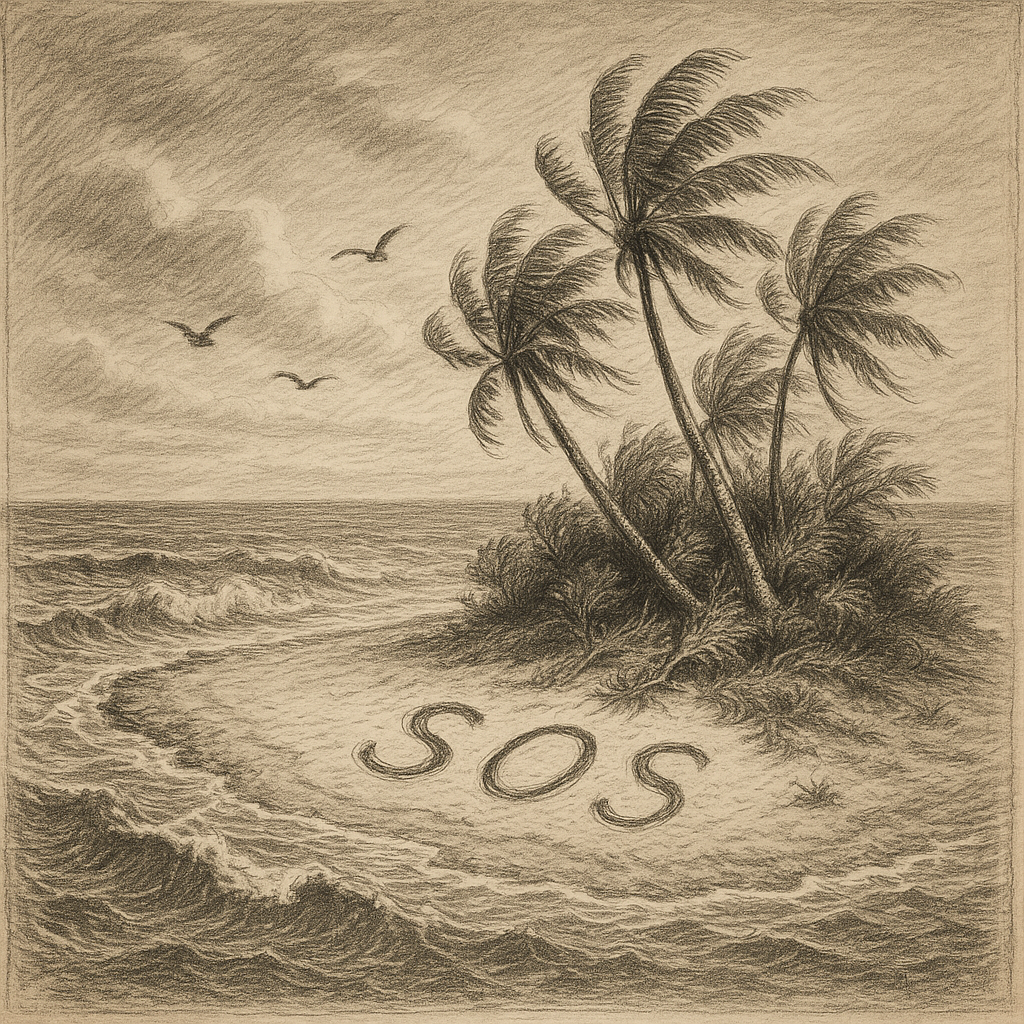
What gives this island its unusual modern reputation is not conquest, colonization, or commerce, but rescue. In 2020, three men from Pulawat Atoll were found there after their small boat ran out of fuel and drifted off course. They had spelled out SOS on the beach, a message visible from the air, and Australian and U.S. search crews helped locate them. The story traveled widely because it seemed almost archaic: a tiny Pacific island, a stranded boat, men surviving on coconuts and whatever water they could gather, and salvation depending on whether anyone would notice a mark in the sand. It was a twenty-first-century incident that felt centuries old.
That episode also revealed something fundamental about places like this. Their significance is intermittent. For years they may seem to belong only to birds, surf, and heat haze. Then, suddenly, they become the center of a search grid, the answer to a distress call, the difference between disappearance and return. On a nautical chart, such an island may look negligible. In an emergency, it becomes enormous.
Reef, birds, and the severe economy of a small island
The physical character of the place is all constraint. Because it is so low-lying, it is vulnerable to storm surge, salt intrusion, and the slow violence of sea-level rise that threatens many coral islands across the Pacific. There is little topographic shelter. Wind crosses it cleanly. Sunlight strikes hard. The reef platform that protects it also limits easy landing, and in rough conditions the island can remain visible but inaccessible, a flat promise behind breaking water.
Ecologically, such islands matter out of proportion to their size. Small, predator-free coral islets provide nesting ground for terns, boobies, and other seabirds that depend on isolated places. The vegetation is typically sparse but functional: enough cover to interrupt glare, enough rooting structure to hold sand in place, enough organic accumulation to support life in a setting built largely from coral debris. These are not lush tropical fantasies. They are tougher, leaner systems, assembled from salt tolerance and persistence.
There is relatively little public documentation devoted to this particular island compared with larger Micronesian atolls, and that scarcity is itself revealing. Some islands become legible through archives, administrations, and permanent populations. Others remain known chiefly to navigators, fishers, state records, and the occasional crisis. Here, absence is not metaphorical. It is administrative, historical, and physical all at once.
What remains when almost nothing is there
To consider this place closely is to be reminded that remoteness does not always announce itself with cliffs, glaciers, or dramatic ruin. Sometimes it appears as a low line of trees on coral, nearly level with the horizon, where there is nowhere to hide and almost nothing to use. The island’s drama lies in scale: the disproportion between a tiny piece of land and the ocean surrounding it, between its meager resources and the immense value they can suddenly acquire.
That is why the most memorable image associated with it is not a grand landscape but a signal scratched across sand. Few islands are so small and yet so capable of changing a story. In satellite views and official databases it is a minor feature of the Caroline chain. In human terms, at the right hour, it is something far rarer: proof that in the middle of a vast sea, a little land can still answer back.