A white shard in the Central Pacific
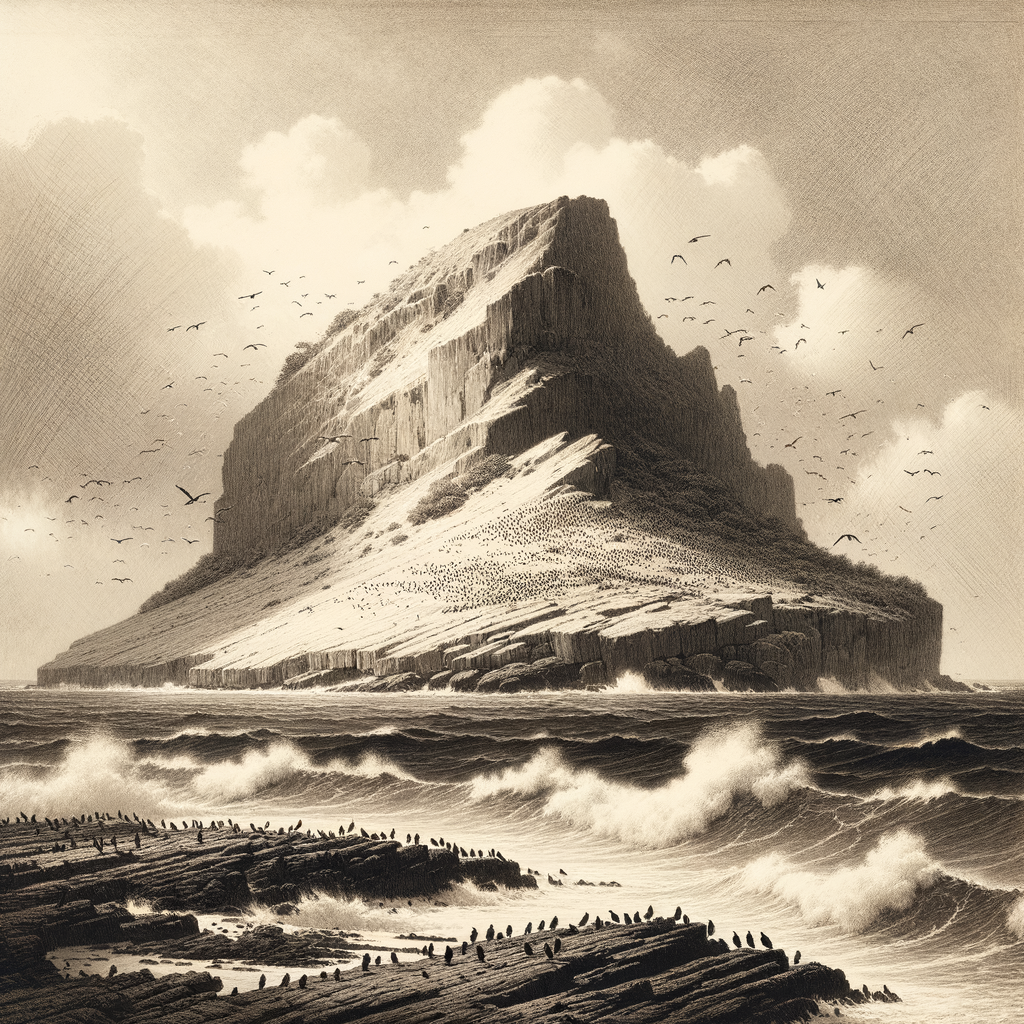
Far out in the central Pacific, where charts seem to empty into pure distance, McKean Island lies low and hard under the sun: a small, raised coral island in the Phoenix Islands of Kiribati, with no trees, no fresh water, no harbor, and no permanent human life. It is not the sort of place that invites arrival. From the sea it appears as a pale, angular strip of limestone and coral rubble, ringed by surf, exposed to salt, heat, and wind. The island covers only a fraction of a square mile, yet its remoteness gives it an outsized presence. Everything about it feels reduced to essentials: glare, seabirds, reef, sky.
That starkness is geographical fact, not literary embellishment. The island stands just north of the equator within one of the most isolated island groups on Earth. Unlike the lush atolls that often shape the romantic image of the Pacific, this one is dry and almost treeless, its surface rising only modestly above the ocean. There is no protecting lagoon. Waves meet the reef directly, and landing has long been difficult. Such places tend to remain mostly themselves because they are inhospitable to nearly everyone except the species that have learned to live on them.
Seen, named, and mostly left alone
Its recorded history is thin in a way that suits the landscape. The island entered the written world through nineteenth-century navigation, part of the age when American and British vessels threaded the Pacific in search of whales, trade, and safe routes through immense spaces. Like other remote islands, it was more often noted than inhabited: a point on a chart, a hazard, a landmark for mariners who knew how much trouble an unnoticed reef could cause.
In the nineteenth century, as guano became one of the Pacific’s strangest strategic resources, even barren specks like this acquired value. Seabird colonies had laid down deposits that could be mined for fertilizer, and remote coral islands across the ocean were claimed, surveyed, and occasionally worked. McKean Island was among the islands of the Phoenix group drawn into that history. Yet if guano briefly linked it to global commerce, the connection only emphasized how difficult and peripheral the place was. No settlement endured. No port grew. The island slipped back toward the condition that had defined it for centuries: visited rarely, occupied by birds rather than people.
Today it forms part of the Phoenix Islands Protected Area, one of the largest marine protected areas on the planet when established in 2008. That designation matters because isolation alone has never guaranteed safety. Even the most inaccessible islands have been altered by passing ships, accidental introductions, and extractive schemes conceived far away. Protection acknowledges that remoteness is precious, but also vulnerable.
A kingdom of seabirds, written in salt and guano
If human history here is fragmentary, natural history is not. The island is best understood as a breeding station for oceanic birds, a place where vast distances collapse into instinctive return. Red-footed boobies, masked boobies, sooty terns, and great frigatebirds are among the species recorded there, using the island as a nesting ground in a region where secure predator-free sites are exceptionally important. On a bare coral platform with no stream, no shade, and almost no softness, life gathers in noisy abundance.
The ground itself bears the evidence. Guano is not incidental scenery but one of the island’s defining substances, part of the chemistry that shaped its ecological story and drew human attention in the first place. In such environments, nutrients arrive by wing. Birds feeding far out at sea return and deposit what the open ocean withholds, enriching the island in concentrated pulses. Insects, salt-tolerant plants, and nesting cycles all become tied to that exchange between reef and sky.
There is another, darker ecological chapter as well, one familiar across the world’s remote islands. Introduced rats once reached the island and preyed on eggs and chicks, damaging the breeding colonies. Their eventual eradication, carried out in the early twenty-first century as part of conservation work in the Phoenix group, was not dramatic in the cinematic sense, but it was consequential. On islands this small, the removal of an invasive predator can shift the entire balance back toward seabirds. Recovery in such places is one of the quiet triumphs of conservation: no spectacle, just more nests, more calls in the heat, more life reclaiming a place that had evolved without mammalian hunters.
What survives at the edge
There are islands that become famous because people transformed them. This one is memorable for the opposite reason. It resists almost every familiar human use. It offers no village history, no ruins softened by vines, no anchorage where stories comfortably gather. Its atmosphere comes from exposure. The light is severe, the scale deceptive, the silence never complete because birds and surf keep speaking into it.
That is why such a small island can feel so immense in the imagination. It stands in a region of ocean that still has the power to make human presence seem temporary and contingent. A place like this clarifies what islands are before they become destinations or settlements: fragments of geology and biology, ringed by hazard, claimed more convincingly by wind and wings than by any flag.
In the end, the fascination lies in how little has been imposed on it. A low coral island in the Phoenix group, almost blank on the map except to navigators, ornithologists, and conservationists, remains what the modern world rarely allows anything to remain: austere, difficult, and overwhelmingly itself.