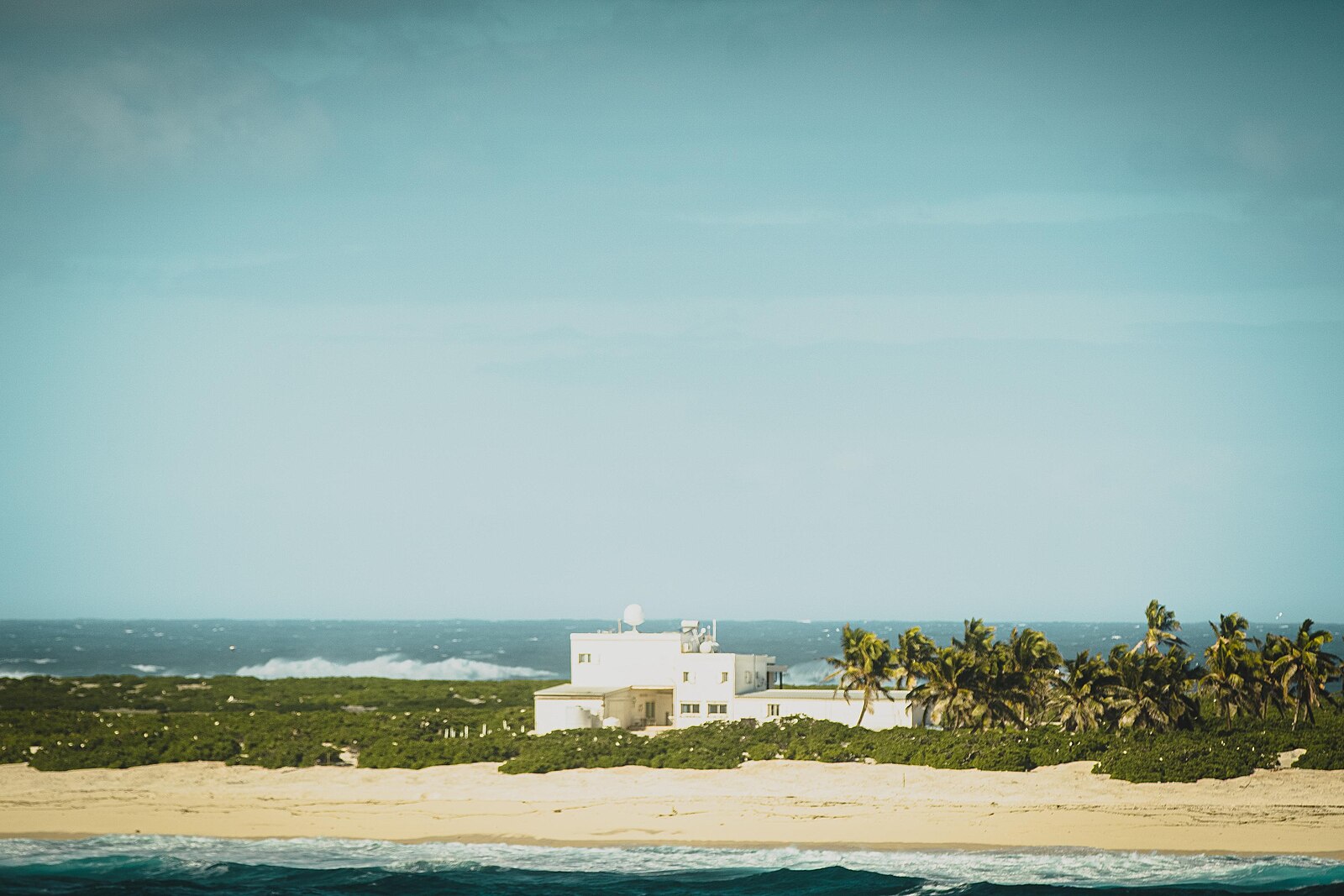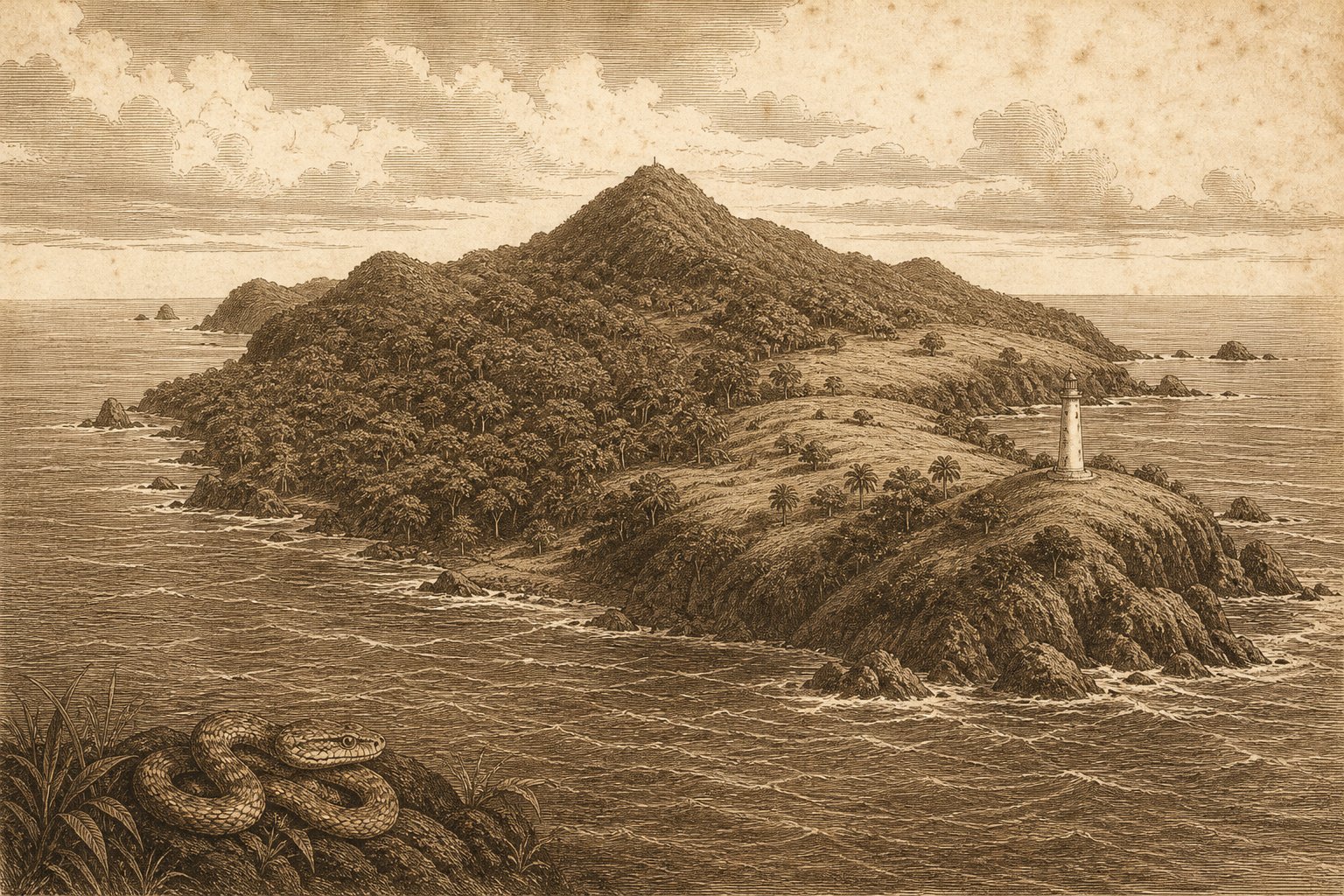
Beyond a stretch of Atlantic water, a forested island gives an approaching sailor a place on which to fix the eye. Queimada Grande Island (Ilha da Queimada Grande), off southeastern Brazil, invites attention beyond that first outline: to the leaves, the air within the vegetation, the ground enclosed by the shore. From the sea, the forest can be imagined as a continuous green surface. Within it, the scale changes to individual plants and the spaces between them. The pull of this small island begins there, in the difference between seeing land across open water and knowing something of what lives upon it.
For a mind drawn toward distant shores, the attraction need not depend on an immense ocean crossing. Brazil administers the island, and ICMBio is responsible for its federal conservation area. It lies about 30–35 km from the southern São Paulo coast, near Itanhaém. The mainland supplies a familiar reference on the map; beyond it lies a small forest whose separation from the coast has consequences far greater than the distance alone suggests.
A lighthouse beyond the coast
The Brazilian Navy built the lighthouse in 1909, placing a structure with a practical purpose among the island’s vegetation. The light served navigation. Alongside the forest and surrounding water, the building gives the eye something made to a human scale, a reason for people to have crossed from the mainland and worked here. Its presence allows a plain kind of attention: to a workplace separated from the coast, and to the difference between passing an island and having duties on it. No account of an extraordinary voyage is needed to make that distinction felt beside the trees and open sea.
On a map of Atlantic islands, the eye can travel onward to Trindade Island or Beauchene Island, following the same appetite for land separated by water. Here, the approach holds attention close to Brazil. The surrounding sea remains part of the view even when the forest becomes its center. At that distance, individual plants cannot explain the place; the observer has only the broad appearance of vegetation and the shore around it. The island asks for closer attention than its outline can satisfy, and for patience with what remains indistinct from offshore.
The keepers and the rain
Lighthouse keepers lived here until 1925, when the light became automated. Residence meant more than a crossing. Their workplace stood on an island with a warm, rainy season from October through March and a cooler, drier season from April through September. These are the conditions around the human history, without requiring an invented storm or a lonely farewell. The keepers had a task that required their presence; the seasonal weather gives that simple fact a physical setting. Beside the building was vegetation exposed to rain, with the sea separating the place of work from the mainland coast.
Humidity exceeds 90%, bringing the air itself into any thought of time spent here. Rainforest covers much of the island, so an account confined to open sea and sky would leave out the close surroundings on land. Leaves occupy the view. Within the vegetation, the sensation is of moist air and nearby growth, rather than the unobstructed distance that first draws attention offshore. The distinction gives substance to the thought of staying: the island has an interior as well as a perimeter, and the weather is present among the plants as surely as it is over the water.
The snake within the forest
The golden lancehead (Bothrops insularis) is endemic to this island. Its entire natural range is here. The mainland across the water does not extend that range, however close the coast may seem on a regional map. For an imagination accustomed to following navigators toward another shore, this fact changes the direction of attention. The interest lies within the island’s boundaries, on the limited ground available to a living species. The animal deserves consideration at that scale, without an invented encounter in the undergrowth or a dramatic scene imposed on a forest that is already particular enough.
The vegetation deserves attention of its own, beyond its role as the setting for the snake. A botanical inventory recorded 125 vascular plant species, giving the apparently continuous forest a more varied identity. The green outline resolves into individual plants. The invasive grass Melinis minutiflora occurs here too; surrounding water does not make the vegetation free of invasive species. Close observation therefore changes the view in a practical way, distinguishing plants that cannot be separated in an offshore impression. The forest contains more than that first expanse of green reveals, even before attention turns to the animals within it.
The light after the keepers
The lighthouse is periodically maintained, preserving a practical connection with the coast. Scientific work continues as well. A genomic study published in 2025 produced a near chromosome-level reference genome for the golden lancehead, described as critically endangered. This is close attention at a scale unavailable to an observer standing among the plants. Earlier population research left the possibility of decline highly uncertain, rather than establishing a simple downward course. That uncertainty matters alongside the endangered status: there is reason for care, without turning incomplete knowledge into a confident prediction about the animal’s future on this small area of land.
Seen again across open water, the forested outline offers the same place for the eye to settle. Knowledge of the island makes that view more specific without making every part of it visible. For those drawn to distant shores, something remains to be understood beyond the first sight of land: the humid air, the plants distinguishable only at closer range, the animal confined to this ground. The imagination can stay with that difference between the offshore view and the life within it, ending where the water meets the forested shore.
Quick facts
- Location: Atlantic Ocean off São Paulo State, Brazil; 24°29′8″S, 46°40′31″W; about 30–35 km from the mainland coast near Itanhaém.
- Area: About 0.43 km² in the population study; published figures differ, ranging from 0.23 km² in the creation decree to 0.57 km² in the vegetation study.
- Status: Administered by Brazil; ICMBio is responsible for the federal conservation area. Protected together with Queimada Pequena as an Área de Relevante Interesse Ecológico under the 1985 decree.
- Population: Described as uninhabited by humans in the 2010 Journal of Threatened Taxa study; lighthouse keepers lived here until 1925.
- Wildlife/Protection: Home to the endemic golden lancehead, described as critically endangered in the 2025 genomic study; lowland rainforest covers approximately 60% of the island.
Sources
- Brazilian federal government; hosted by ICMBio (1985): Decreto nº 91.887, de 05 de novembro de 1985
- PLOS ONE (2014): Population Dynamics of the Critically Endangered Golden Lancehead Pitviper, Bothrops insularis: Stability or Decline?
- Biota Neotropica; hosted by SciELO (2017): The vascular flora and vegetation of Queimada Grande Island, São Paulo State, southeastern Brazil
- Journal of Threatened Taxa (2010): Sexual dimorphism in development and venom production of the insular threatened pit viper Bothrops insularis (Serpentes: Viperidae) of Queimada Grande Island, Brazil
- Genome Biology and Evolution; hosted by PubMed Central (2025): The Golden Lancehead Genome Reveals Distinct Selective Processes Acting on Venom Genes of an Island Endemic Snake
- Wikidata: Ilha da Queimada Grande (Q181544)