At the Edge of the Pacific
Far out in the North Pacific, where charts begin to feel abstract and the ocean seems to erase the habits of ordinary geography, Midway Island lies low against the horizon: not a mountain rising from the sea, but a ring of coral and sand so slight that from a distance it can appear almost imagined. There is no dramatic skyline here, no volcanic cone announcing itself to sailors from miles off. Instead there is glare, wind, a long wash of surf on reef, and the peculiar stillness of a place that is both tiny and immense because of what surrounds it. More than a thousand miles from Honolulu and closer to Asia in spirit than to any continent in sight, it occupies that unsettling category of place that feels less like land than a pause in the ocean.
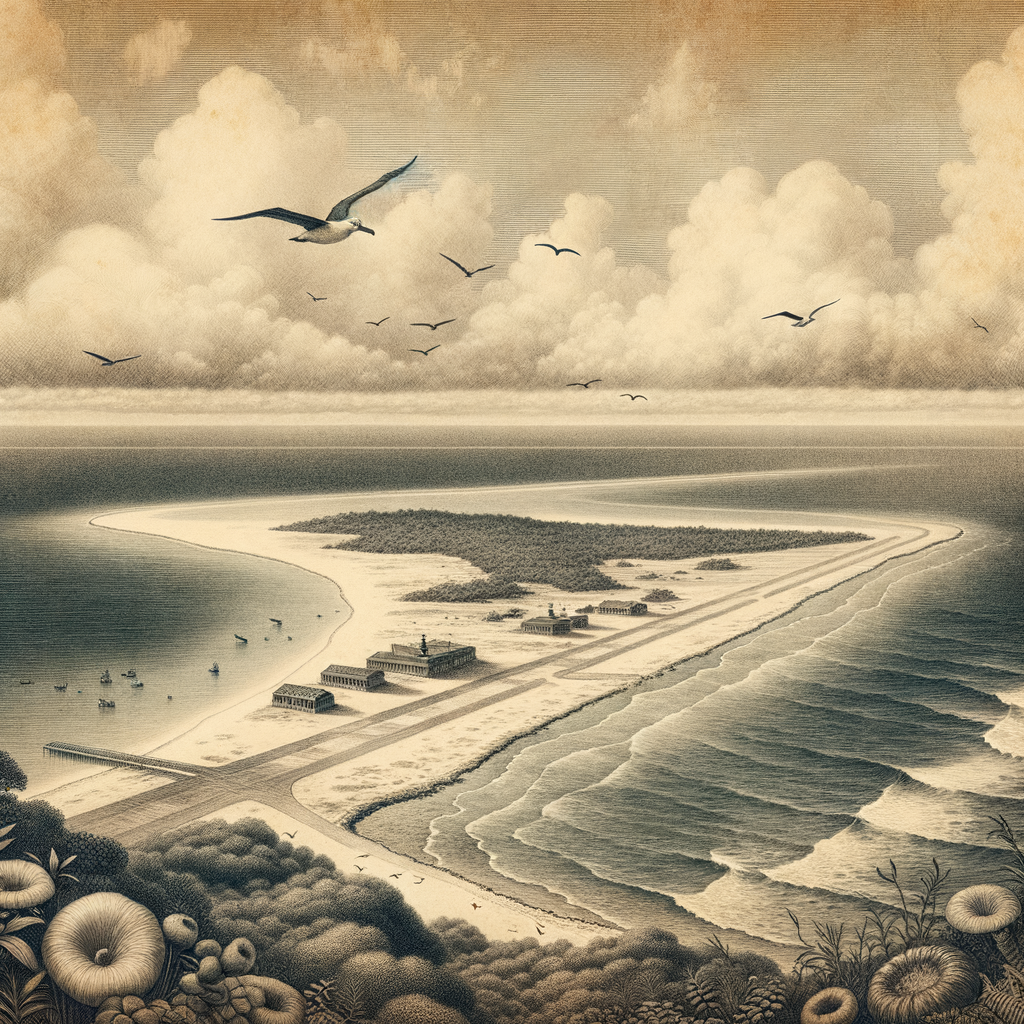
Physically, it is an atoll: a broken circle of coral enclosing a shallow lagoon, with Sand Island and Eastern Island the principal pieces of dry ground. The land stands only a few feet above sea level. Salt air moves through ironwood and low vegetation; beaches shift; storms rewrite edges that were never firm to begin with. The reef is the island’s real architecture, a living rampart built over geological time on the summit of an ancient volcano now drowned far below. What remains above water is fragile, flat, and exposed, yet astonishingly durable in the way coral worlds can be, persisting by adaptation rather than strength.
A Strategic Speck
Its modern history began not with settlement in the usual sense but with imperial reach and navigation. Claimed for the United States in 1867, the atoll took on outsized importance because it sat in the middle distance of the Pacific, a waystation before it became a fortress. In the age of steam and cable, remoteness could be useful. Later came dredging, runways, barracks, fuel tanks, and the hard geometry of military planning imposed on a place that had evolved according to tides and birds.
That transformation reached its most famous moment in June 1942, when the Battle of Midway turned this isolated atoll into the focal point of one of the decisive naval engagements of the Second World War. Japanese forces sought to seize it; American codebreakers, pilots, and sailors met them in a clash fought mostly over open water and sky. The names of aircraft carriers lost there have echoed through military history ever since. On the islands themselves, men endured bombing, fire, and the abrupt violence of a war that had reached one of the most remote outposts under the American flag. It is one of the strange properties of the Pacific that a place so small can become so consequential.
After the battle, the atoll remained a military installation for decades. It later served civil aviation too, as an emergency and refueling stop in the era when crossing the Pacific still required stepping stones. For travelers in airliners, it was a name on route maps, a speck below the window; for those stationed there, it was a world of heat, machinery, seabirds, and distance. Yet strategic logic changes. The military presence receded, regular habitation dwindled, and what had once been crowded with personnel, infrastructure, and wartime urgency entered another phase: not exactly abandonment, but a retreat of permanent human life.
The Realm of Birds and Ghosts of Industry
Now the most numerous residents are not people but birds in extraordinary abundance. This atoll is one of the great seabird colonies of the planet, especially for albatrosses. Millions nest across the low ground, and the sight can be almost surreal: great white birds with dark backs, conducting patient, formal courtship dances on land that once held gun emplacements and runways. Laysan and black-footed albatrosses return year after year, crossing immense distances with a grace that makes human remoteness look clumsy by comparison. Bonin petrels, tropicbirds, terns, and frigatebirds add to the sense that this is less an island inhabited by wildlife than a wildlife city interrupted by old human structures.
The ecological story is not purely serene. Introduced species once disrupted nesting colonies, and the legacy of occupation left contamination that required major cleanup. Sea-level rise shadows every future discussion of the place; an atoll this low has no higher ground to retreat to. Even the most beautiful scenes carry a note of vulnerability. A bird colony that seems timeless exists on land that is geologically temporary and climatically exposed.
There is also a haunting visual contrast that gives the atoll much of its atmosphere. Mid-century buildings, weathered roads, seawalls, and long airstrips remain etched into the coral plain. Some structures have been removed, others linger as relics of a harder age. The effect is not ruin in the romantic stone sense, but something more modern and perhaps stranger: the afterimage of logistics. Here, human ambition was practical, urgent, and heavily supplied; now much of it sits under salt air and bird song. Nature has not erased history. It has settled on top of it.
Silence Beyond the Battle
The island’s lore is inseparable from war, but its eerier reputation comes from the mismatch between the scale of its fame and the scale of its land. People know the battle; fewer picture the actual place, its low horizon and washed-out light, its sense of being one storm tide away from disappearance. Sailors and aviators long understood such places as both refuge and hazard. An atoll could save a vessel or wreck it on invisible coral. It could offer a lagoon, fresh bearings, a runway, a radio signal—and still feel unnervingly provisional, as if the ocean were only tolerating its presence.
Today access is tightly limited, and that restriction deepens the aura. This is not an island encountered casually. It is visited mostly for conservation, management, research, or official purposes, part memorial, part wildlife sanctuary, part warning about how much meaning humans can load onto a sliver of coral. In a world mapped to excess, it remains difficult to reach and easy to imagine wrongly. Perhaps that is why it lingers in the mind.
At dusk, when the wind lowers and the light thins across the lagoon, the atoll seems to return to its oldest identity: a narrow threshold between sea and sky. The Pacific around it is still immense enough to humble fleets, nations, and memory itself. What survives on this low ring of coral is not just history, nor only wildlife, but a particular kind of solitude—the solitude of a place that once stood at the center of world events and now listens mostly to surf, wings, and weather.