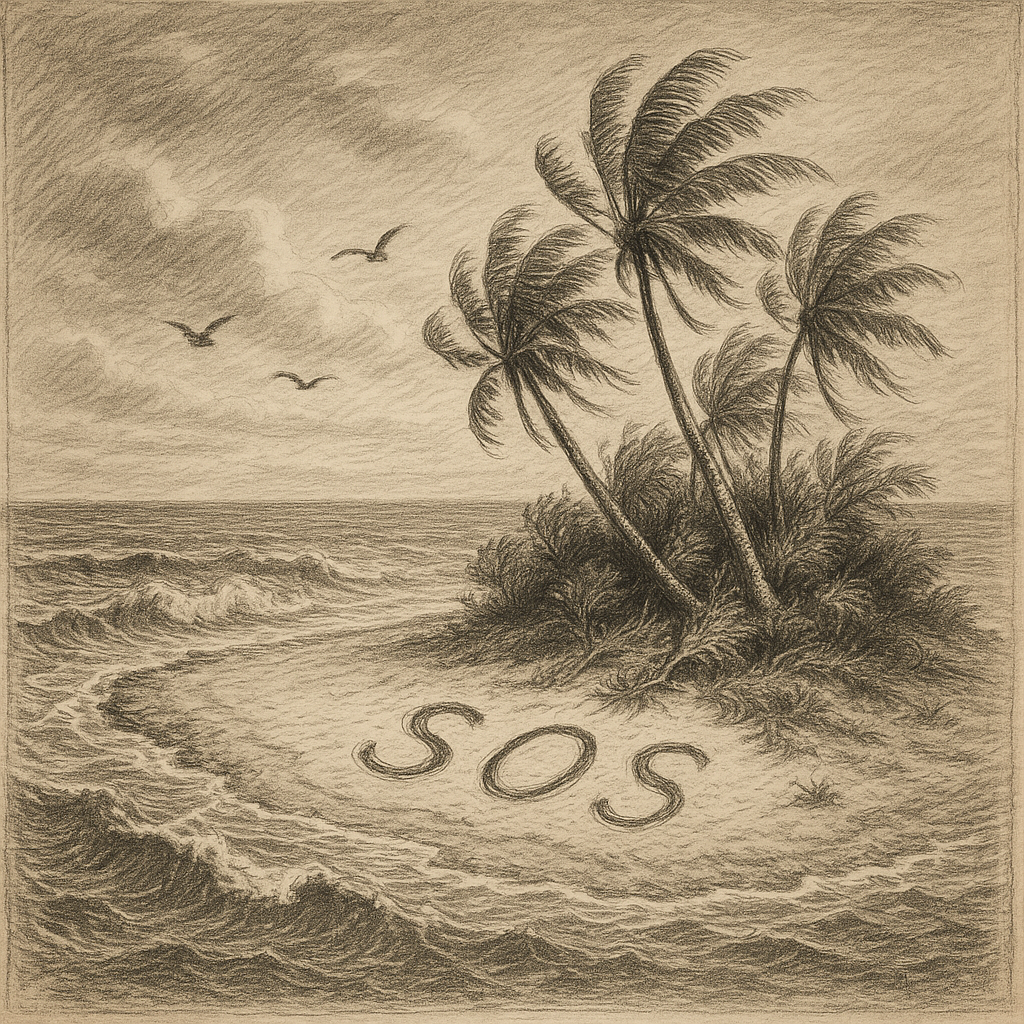
Where the Pacific Turns Quiet
Far out in the northern Cook Islands, almost lost in the blue breadth between Samoa and the Americas, Pukapuka Atoll lies low against the horizon, a ring of coral and green that has always seemed more improbable than grand. There are islands that announce themselves with cliffs, volcanoes, or lagoons wide as inland seas. This one arrives differently: by absence, by distance, by the long intervals of empty ocean around it. Its land barely rises above the Pacific, yet for centuries it has held human life in one of the most isolated inhabited places on Earth.
Geographically, it is a classic coral atoll, though not a perfectly symmetrical one. Three main islets curve around a central lagoon, with a fourth small motu nearby, all built on the skeletons of ancient reef organisms. The highest ground is only a few metres above sea level. Coconut palms, breadfruit, pandanus, and scrub vegetation stand where fresh water is scarce and every storm matters. The surrounding reef is both shield and barrier: it breaks the force of the ocean, but it also makes approach difficult, especially in rough weather. That physical precariousness has shaped everything here. Soil is thin, space is limited, and the sea is never background. It is provider, wall, road, and threat all at once.
The atoll’s remoteness is not a poetic exaggeration but a measurable fact. It sits more than a thousand kilometres north-west of Rarotonga, the administrative centre of the Cook Islands. In practical terms, that means long supply lines, infrequent transport, and a relationship with the outside world that has often been intermittent. Many islands are called remote by travel brochures; this one earned the word long before aviation and satellite maps made the planet seem small.
A Small World with a Deep Past
Long before European ships crossed this part of the ocean, Polynesians had settled the atoll and built a society finely adapted to its restrictions. Pukapukan culture is notable even within Polynesia. Its language, though often grouped within the broader Polynesian family, has distinctive ties that set it somewhat apart from the southern Cook Islands. In older anthropological writing, observers remarked on the community’s strong local identity, its carefully ordered social life, and the practical intelligence required to sustain a population on such limited land.
European contact came late by the standards of the Pacific. The Spanish explorer Álvaro de Mendaña sighted the atoll in 1595 during his voyage across the South Pacific. Later visitors passed through the record in fragments: whaling ships, missionaries, traders, and government officials, each bringing names, maps, diseases, and new forms of power. Christianity arrived in the nineteenth century through the London Missionary Society, as it did across much of the Cook Islands, and transformed local religious life. Yet the place never became a colonial showpiece or a strategic naval outpost. Its history is quieter and, in some ways, more revealing: a history of endurance in a place too small to dominate and too distant to be easily controlled.
That endurance was tested repeatedly. Cyclones have struck with devastating force. Because the land is so low, a powerful storm can seem to erase the boundary between lagoon and ocean, home and flood. One of the most destructive in modern memory was Cyclone Percy in 2005, which caused severe damage across the northern Cook Islands. On an atoll like this, disaster is not an abstraction measured in wind speed alone; it is salinated soil, uprooted trees, damaged houses, broken boats, and the sudden knowledge of how thin the margin of safety really is.
Life on the Edge of the Reef
For all its vulnerability, the place is not empty in either ecological or human terms. Reef fish, seabirds, coconut groves, and the lagoon’s shifting life have long sustained the community. Traditional subsistence relied on a delicate mix of horticulture and fishing, with techniques refined over generations. Anthropologists and Pacific historians have often been drawn to atolls precisely because they reveal, with unusual clarity, how culture can grow out of environmental limits. Here, every planted tree and every preserved canoe route once carried consequences.
The atoll is also one of those Pacific places where the map can mislead. From above, it looks slight, almost decorative. On the ground, it is intimate and immense at the same time. The horizon is always near, but so is weather. The lagoon can seem sheltered, then suddenly harden under wind. The reef flat glitters at low tide with deceptive calm. Isolation here is not only a matter of mileage from the nearest capital; it is a sensory condition, made of bright salt light, trade winds, and the continuous percussion of surf beyond the palms.
There is maritime lore in that setting even when no single famous legend dominates the written record. For generations of sailors, low coral islands were among the most unsettling landfalls in the Pacific: difficult to see until close, dangerous in darkness, and edged by reefs that could destroy a ship within sight of shore. Such places entered navigation not as romantic escapes but as tests of judgment. The atoll belonged to that world of careful dead reckoning and anxious lookout, when a narrow line of palms on the horizon could mean water, shelter, wreck, or survival.
The Lasting Spell of a Low Island
What lingers most is the scale of its existence. Not the size on a chart, but the human scale of a community carried across centuries on fragments of coral in a huge ocean. The modern world reaches even here, of course, through government, radio, flights when available, imported goods, and migration outward to New Zealand and elsewhere. Yet the old facts remain in place. The land is still narrow. The reef is still decisive. The weather still has the final word.
Many remote islands impress by seeming untouched because nobody lives there. This one is more interesting for the opposite reason. It shows what habitation looks like when geography offers almost nothing for free. In that sense its atmosphere is not the silence of abandonment but something rarer: the poise of long persistence. Out on the north-western edge of the Cook Islands, where the Pacific seems to keep secrets simply by being so vast, that low arc of coral remains what it has long been — vulnerable, self-contained, and unforgettable.