In the middle of the South Atlantic
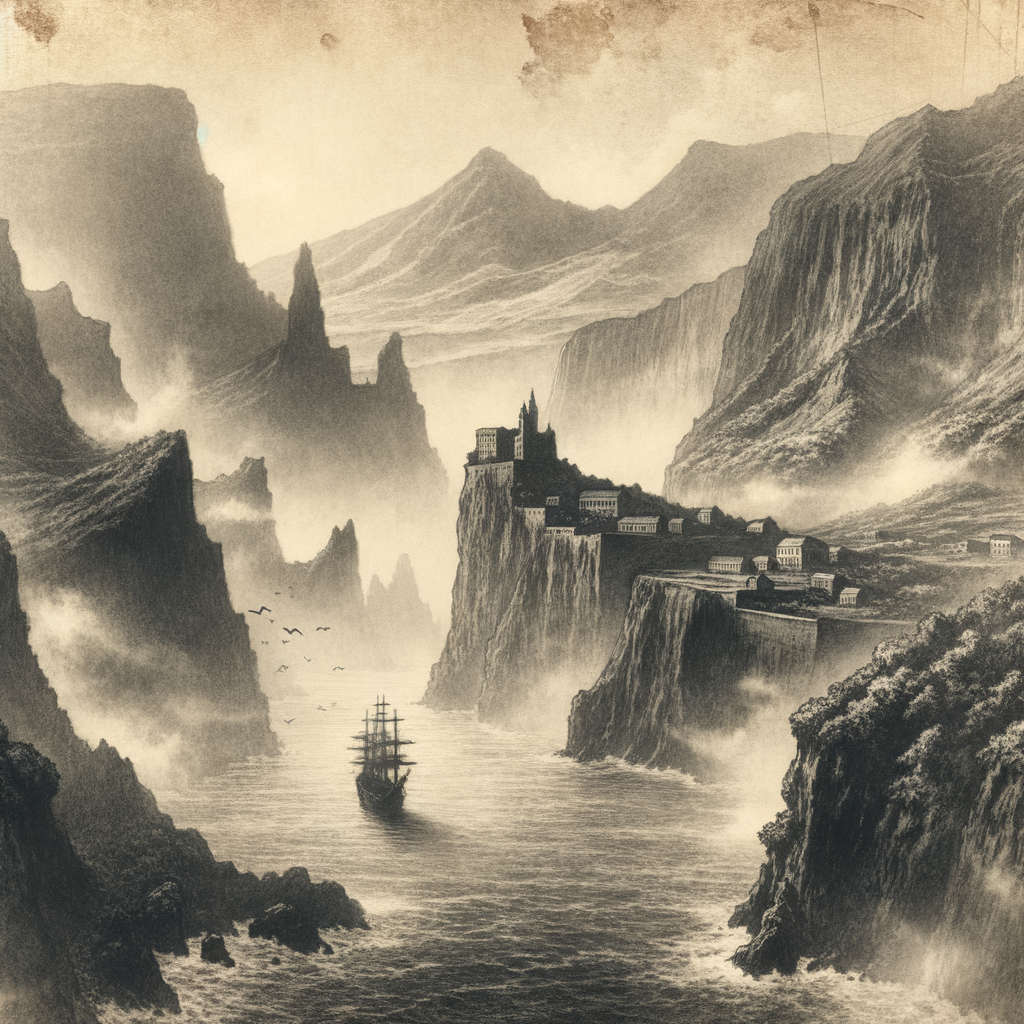
There are islands that seem made for maps, and others that feel almost like afterthoughts of geology and weather, left far out in the ocean where shipping lanes thin and horizons become absolute. St. Helena belongs to the second kind. It rises alone in the South Atlantic, roughly midway between Africa and South America, not as a low coral ring but as a dark volcanic mass with cliffs that appear suddenly from the sea. For centuries, sailors described the first sight of it with relief. After weeks of open water, the land looked improbable: a fortress of rock, deeply cut by ravines, its interior greener than the stern outer walls suggested. Even now, approached by ship, it can seem less like an island than a stronghold placed in the ocean by some severe imagination.
Its isolation is measurable in miles, but the deeper impression is one of enclosure and exposure at once. The coast is mostly abrupt, with towering basalt cliffs and narrow valleys descending toward the sea. Jamestown, the small capital, sits in one of these steep clefts, wedged between near-vertical slopes and the harbor. Beyond the barren outer faces, the uplands can be unexpectedly cool and damp. Clouds gather on the heights. The central ridge catches moisture, feeding pockets of greener country, while lower, drier zones remain harsh and wind-worked. This sharp compression of landscapes gives the place a peculiar intensity: arid slopes, fern-rich high ground, sudden views into immense emptiness.
A port of refuge, and a prison in the sea
The island was first recorded by the Portuguese in 1502, uninhabited when they found it. For a long time, that was one of its defining facts. No Indigenous population waited on shore; no older ruins complicated its story. It entered written history as a stopping place, a chance water source and replenishment station for long-distance voyages between Europe and Asia. In the age of sail, that made it precious. The East India Company later took control, fortifying and settling it. What had been a lonely landmark in the ocean became a strategic victualling station, a place where ships could pause, repair, and recover before plunging back into the immensities.
Yet its name is inseparable from captivity. In 1815, after Waterloo, Napoleon Bonaparte was sent here precisely because escape seemed nearly impossible. The logic was geographical and merciless. Elba had proved too close to Europe; this volcanic outpost was different. It lay so far from any continent, and under such close British watch, that the sea itself became a wall. He spent the last years of his life at Longwood House on the island’s windy heights, under skies often described as bleak, in a landscape at once beautiful and confining. That episode fixed the island in the global imagination. It ceased to be merely remote and became symbolic: the edge of power, the terminus of ambition, the place beyond which there was nowhere else to go.
A damaged Eden
Long before modern conservation language existed, this isolated fragment of volcanic land had evolved a world of its own. Because it stood alone for millions of years, species arrived rarely and then adapted in unusual ways. The island once supported rich native woodland and an extraordinary flora, including plants found nowhere else on Earth. But isolation can make life both inventive and fragile. Goats, invasive plants, deforestation, and centuries of grazing transformed much of the original environment. What early visitors encountered and what survives today are not quite the same world.
Even so, the ecological distinctiveness remains striking. In the cloudier uplands, conservation work has tried to protect remnants of native habitat, and the most celebrated survivor is the St. Helena ebony, a tree long thought extinct until living specimens were rediscovered in the twentieth century. The wirebird, the island’s last remaining endemic bird, still runs across open ground with a brisk, alert fragility, a species whose continued existence depends on careful management of a landscape humans profoundly altered. Here, natural history is not a decorative backdrop. It is part of the island’s character: rarity under pressure, survival in isolation, a biota shaped by both ancient separation and recent damage.
What sailors saw, and what the sea remembers
Remote islands gather a special kind of lore even when formal legend is sparse. This one earned its aura from seafarers, exiles, and the long memory of maritime routes. For East Indiamen and other vessels, it was a place of salvation after monotony and risk, a known point in a nearly trackless ocean. To miss it could mean hardship; to reach it meant fresh water, food, letters, and news from the world. The emotional force of such landfalls is easy to underestimate now. In the age of sail, an isolated harbor could feel almost miraculous.
There is something eerie, too, in the mismatch between the scale of the Atlantic and the narrow valleys where human life took hold. Fortifications cling to rock. Roads and stairways are forced into severe topography. The famous Jacob’s Ladder rises beside Jamestown in a punishing straight line, connecting the town to the heights above like a piece of military geometry imposed on a cliff. Again and again, the landscape gives the same impression: discipline and endurance in a place never inclined to make either easy.
The aftertaste of remoteness
For much of its modern history, access was part of the story. Before the airport opened in the twenty-first century, the journey usually required days at sea aboard the RMS St Helena, one of the last links of its kind. Arrival was slow, earned, and therefore unforgettable. Even with air service now available, the sense of being far from everywhere has not vanished. It is built into the island’s proportions, its weather, its cliffs, and its history.
What lingers most is not a single event, not even Napoleon, but a mood: a small inhabited place carrying the weight of immense distances. Few islands feel so completely enclosed by oceanic solitude while remaining so dense with human consequence. It is a refuge, a prison, a damaged sanctuary, a maritime landmark, a relic of empire, and a living community all at once. Stand on the heights and the Atlantic appears almost abstract in its vastness. Then look down into the cut valleys, the old defenses, the green folds hidden behind black rock, and the abstraction becomes intimate. The island is not empty. It is concentrated. That may be why it stays in the mind so stubbornly: not as a dot in the ocean, but as a place where the world, having thinned to sea and wind and cliff, somehow feels larger than ever.