A name earned in rough water
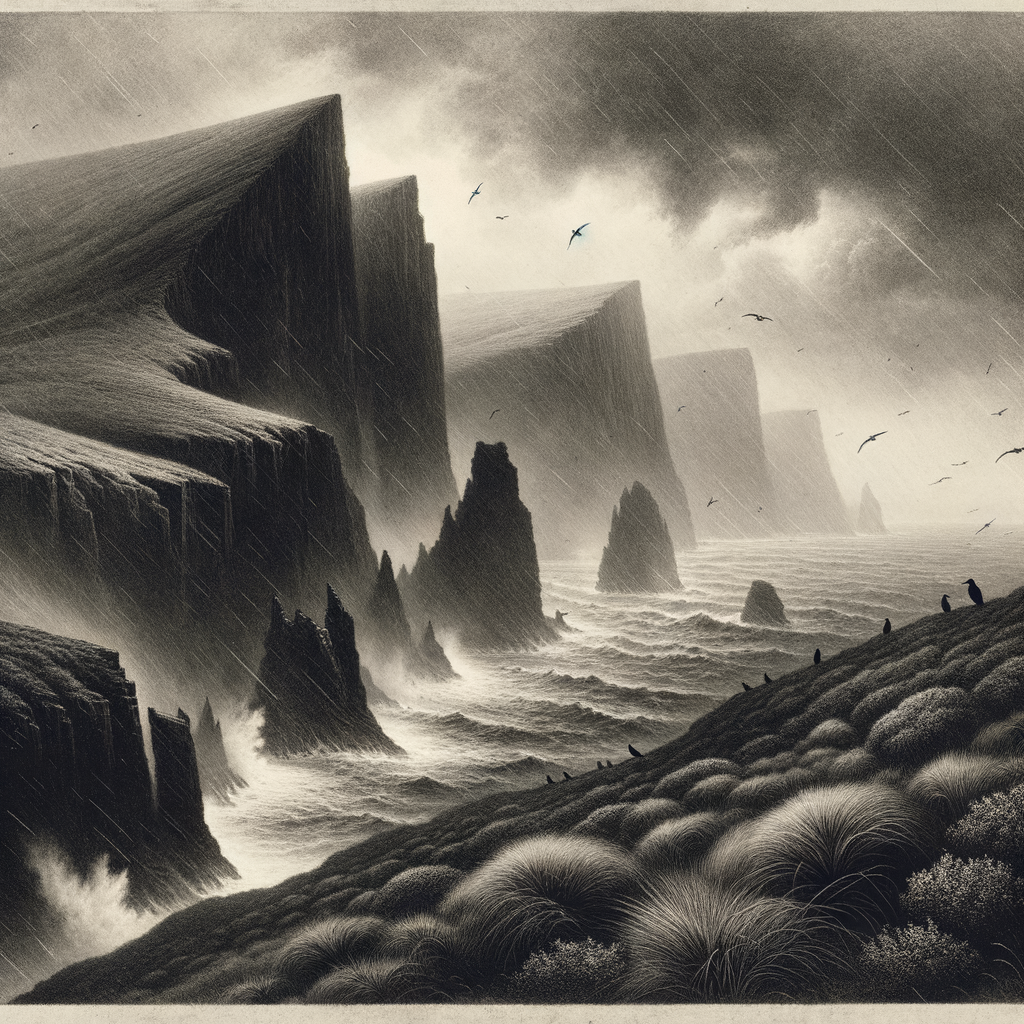
South of New Zealand, where the Southern Ocean strips away any illusion of softness, Disappointment Island sits as a hard, cliff-bound outlier of the Auckland Islands group. It is small, uninhabited, and difficult to approach, a place whose title sounds theatrical until the surrounding facts make it plain. The island lies northwest of the main Auckland Island, separated from it by a narrow channel, and rises from cold seas in steep slopes and rock faces rather than in any inviting beach or harbor. Wind dominates the scene. So do rain, mist, and the long heave of subantarctic weather moving across open water with little to slow it.
Geologically and botanically, it belongs to that remarkable subantarctic belt in which isolation and exposure produce landscapes that seem pared down to essentials. The ground is often cloaked in low vegetation typical of these islands: tussock, herbfield, and shrub adapted to saturation, salt, and cold. Trees do not define the silhouette here. Instead, the island presents itself in darker masses: cliffs, ridgelines, and densely weathered surfaces above a restless sea. The surrounding waters are notorious enough that even its nearness to another island does not make it feel companionable. On maps, the distance is modest. In lived conditions, it is a barrier of current, swell, and temperature.
Shipwreck country
The island’s reputation was fixed not by settlement but by catastrophe. In the nineteenth century, these waters became part of one of the grimmest chapters in New Zealand maritime history. The best-known disaster connected with the island occurred in 1866, when the brig General Grant, carrying passengers and cargo including gold, was wrecked on the western side after entering a sea cave. Some survivors escaped the wreck, but not all made it through the aftermath. A group was put ashore on Disappointment Island, where conditions quickly turned lethal. According to documented accounts, several died there before the remaining survivors were eventually rescued months later.
That episode helped secure the island’s bleak place in southern maritime lore. The wreck of the General Grant later inspired repeated treasure searches, because of the gold reported lost with the ship, but the human reality behind those expeditions was harsher than the legend. This was not a romantic island of clues and buried wealth. It was a place where exposure, lack of shelter, and the sheer difficulty of moving people across short but violent stretches of sea could decide who lived and who did not.
The wider Auckland Islands were themselves a graveyard of vessels in the age of sail, dangerous because of fog, wind, and uncertain navigation at the edge of major routes. Castaway depots were eventually established in the archipelago to improve the odds for survivors of wrecks, a practical response to repeated disaster. That history matters here because the island is inseparable from the conditions that produced it: not just remoteness in the abstract, but remoteness sharpened by cold, surf, and the terrible slowness of rescue in the subantarctic.
Bird cliffs and guarded ground
If people came to this island in fear or by accident, seabirds arrived by ancient right. It is internationally important as a breeding site for the Antipodean albatross, Diomedea antipodensis, one of the great oceanic birds of the South Pacific. Major colonies nest here, using the island’s relative freedom from introduced predators as an advantage of immense biological value. In a region where human arrival often transformed island ecosystems, the absence of permanent habitation on this particular piece of land became, over time, one of its most consequential facts.
The island also forms part of the New Zealand subantarctic islands UNESCO World Heritage area, recognized for exceptional natural value. Access is tightly controlled. That restriction is not incidental bureaucracy; it reflects ecological fragility and the significance of these islands as breeding grounds for birds and marine mammals in one of the planet’s most demanding environments. To land casually would be to misunderstand the place. It is not empty in any simple sense. It is occupied by weather systems, nesting cycles, and the old disciplines of the sea.
Even the light seems conditional there. Photographs taken on clear days show green slopes and black rock above pale water, but clarity is never the whole story. Cloud can lower suddenly, and distance can collapse into haze. Seen from a vessel, the island often appears less like a destination than an interruption: an abrupt lift of land in a latitude where the ocean usually has the last word.
What the charts cannot soften
There are islands whose isolation invites daydreams of escape. This is not one of them. The fascination comes from something sterner: the convergence of exact geography, maritime loss, and ecological importance in a place with no audience and no ordinary human rhythm. It remains largely what weather and seabirds require it to be, while history reaches it mostly in fragments — a wreck, a name, a few desperate months remembered because they were survived at all.
That may be why it lingers in the mind. Not as a blank spot, and not as a melodrama, but as a sharply real island in a belt of ocean where names had to be practical. Some places can be described by what they contain. This one is also defined by what it denies: easy landing, safety, repetition, permanence. Beyond the charts and official designations, that denial is the atmosphere that still surrounds it, as cold and unmistakable as the sea.