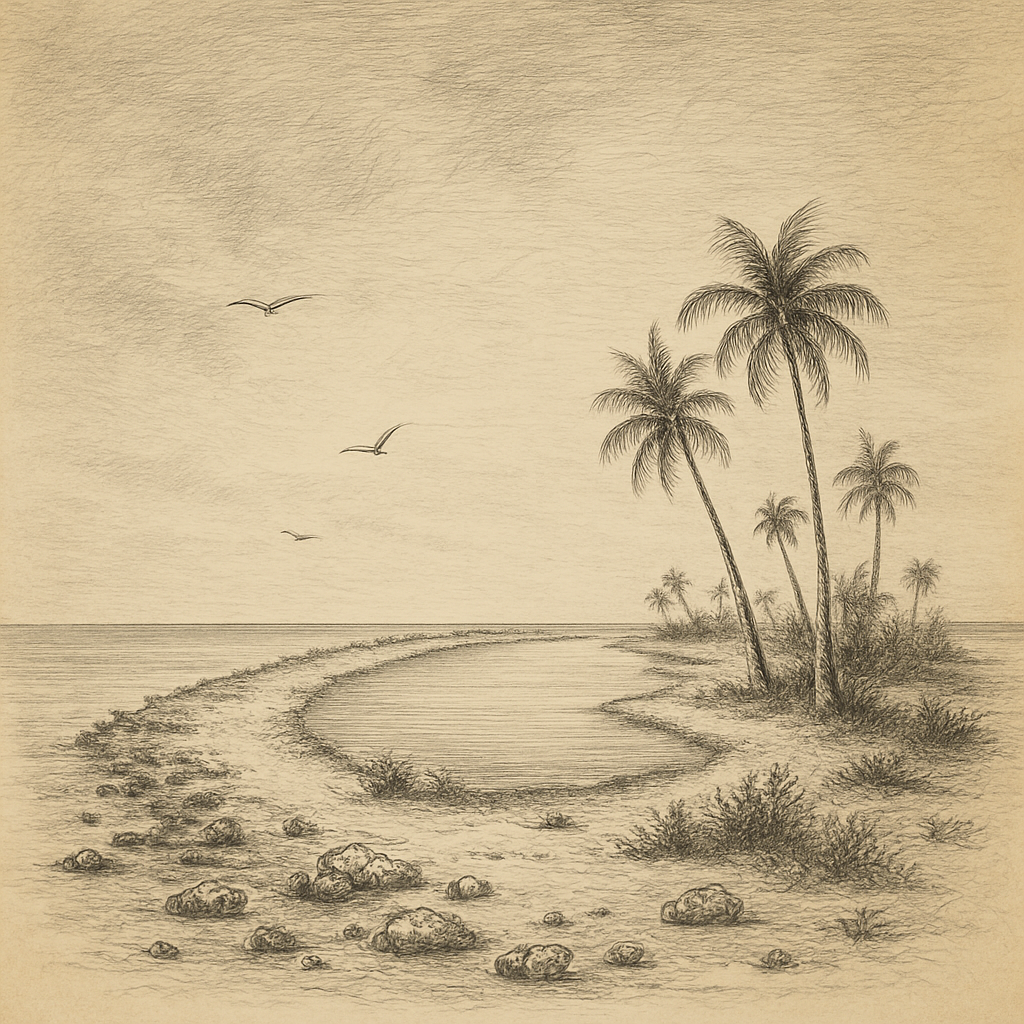
Far out in the southern Line Islands, where the central Pacific seems to thin into glare and distance, Flint Island lies low against the horizon, an atoll so remote that its very scale feels deceptive. It belongs to Kiribati, yet it sits far from the country’s better-known inhabited atolls, about as isolated as a coral ring can be while still carrying a name on the chart. There are no mountains to announce it, no harbor folded into its edge, no settlement pressing human shape onto the land. What rises instead is a long, narrow atoll enclosing a lagoon, with a landscape formed by coral debris, sand, scrub, and coconut palms under a climate of heat, salt, and relentless light.
Its dimensions are modest on a world map and strangely elongated when seen more closely: a sliver of land wrapped around lagoon water, barely elevated above the sea. Like other low coral atolls, it is vulnerable by design. The ground is porous, fresh water limited, and the entire place exposed to the weather systems of the open ocean. This is not the lush, high-island Pacific of waterfalls and volcanic ridges. It is a flatter, harsher geometry, where the horizon dominates and the line between habitable ground and precarious ground is always narrow.
Copra, seabirds, and a hard kind of emptiness
For all its remoteness, the island did not remain untouched by the commercial logic that reached so many Pacific atolls in the nineteenth century. It was claimed by outside powers during the era when guano, copra, and strategic position drew imperial attention across the ocean. In time it came under British control as part of the Line Islands and later passed into the independent Republic of Kiribati. The rhythm that mattered most here was not urban growth or permanent village life, but extraction: coconut planting and copra production, the standard economic script imposed on many small atolls.
That script never overcame the place. Some Line Islands developed enduring settlements; this one did not. Workers came and went. Plantations altered vegetation, but they did not create a durable society. The reasons were plain enough: isolation, limited resources, difficult supply, and an environment that offered little margin for error. The island’s human history is therefore fragmentary in the documentary sense, more visible in administrative records and economic schemes than in the layered civic life that marks larger Pacific communities.
What persisted more convincingly than commerce was bird life. Remote coral islands have long served as breeding grounds for seabirds, and this atoll has been recognized as important habitat within the southern Line group. Such places accumulate life in concentrated forms: terns, boobies, frigatebirds, and other ocean-ranging species using land not as a home in the human sense but as a necessary interruption between vast arcs of flight. The ecological value of a low atoll can be easy to underestimate until one remembers how little undisturbed nesting ground remains across the tropical Pacific.
A place on old routes, but not of them
The island’s name appears in navigational history, though like many Pacific atolls it passed through eras of uncertain sightings, overlapping reports, and the imperfect certainties of mariners working at the edge of known geography. By the nineteenth century it was fixed more securely in the records of naval and commercial travel. Yet it never became one of those islands that gathered dramatic colonial architecture, missionary stations, or dense archival afterlives. Its story is quieter and, in some ways, more revealing. It shows how many places entered global history only briefly, through the practical interests of shipping and plantation enterprise, before slipping back into near-silence.
There is something severe in that pattern. Many remote islands are famous because something happened to them. Here, the fascination lies partly in how little happened that could outlast the conditions themselves. Heat, salt, birds, surf, and abandonment have done more to define the atoll than any celebrated expedition. Even the traces left by human use belong to a familiar Pacific cycle: outside claim, economic trial, logistical difficulty, retreat.
No robust body of folklore or documented legend appears to cling to the island in the way it does to more storied landfalls. The absence matters. It leaves the place unusually bare in the historical imagination, a real island with fewer inherited narratives than its remoteness seems to invite. What remains instead is maritime knowledge of a difficult, far-scattered ocean and the practical recognition that some islands were always more useful as marks on a route than as destinations in themselves.
After the map gives you the name
Seen in that light, Flint Island becomes more than a distant possession or a minor atoll in a far-flung republic. It is an example of a particular Pacific reality: land that exists on the edge of viability, historically visited by trade, altered by plantation ambition, and then left largely to weather, birds, and time. Its low profile and remote position make it easy to overlook, but they also sharpen its character. Nothing here softens the facts of exposure. The ocean is close on every side; the ground is slight; the future, as on so many coral atolls, is tied intimately to forces larger than any settlement could control.
That is why the island lingers in the mind. Not because it is rich in spectacle, and not because history crowded it with famous events, but because it stands in a form of pure remoteness that modern life rarely encounters. A ring of coral and vegetation in the immense Pacific, once used, briefly occupied, and now quiet again, it remains exactly the sort of place that reminds us how much of the world lies beyond traffic, beyond routine, beyond the comforting illusion that every named point on the map has been thoroughly drawn into human life.