Nothing about this place invites arrival. A low strip of coral and rubble breaks the Pacific almost on the Equator, far south of Hawaii and far from regular sea lanes, without a harbor, without fresh water, without even the dramatic relief that helps many remote islands announce themselves. Jarvis Island is difficult to see, difficult to land on, and easy to imagine as a mirage until the charts insist otherwise. Its very plainness is part of its force. Here is one of the world’s more absolute margins: a hot, dry, wind-scoured American possession in the central Pacific, uninhabited and closed to casual visitors, surrounded by reefs and surf and a field of blue that seems to go on without argument.
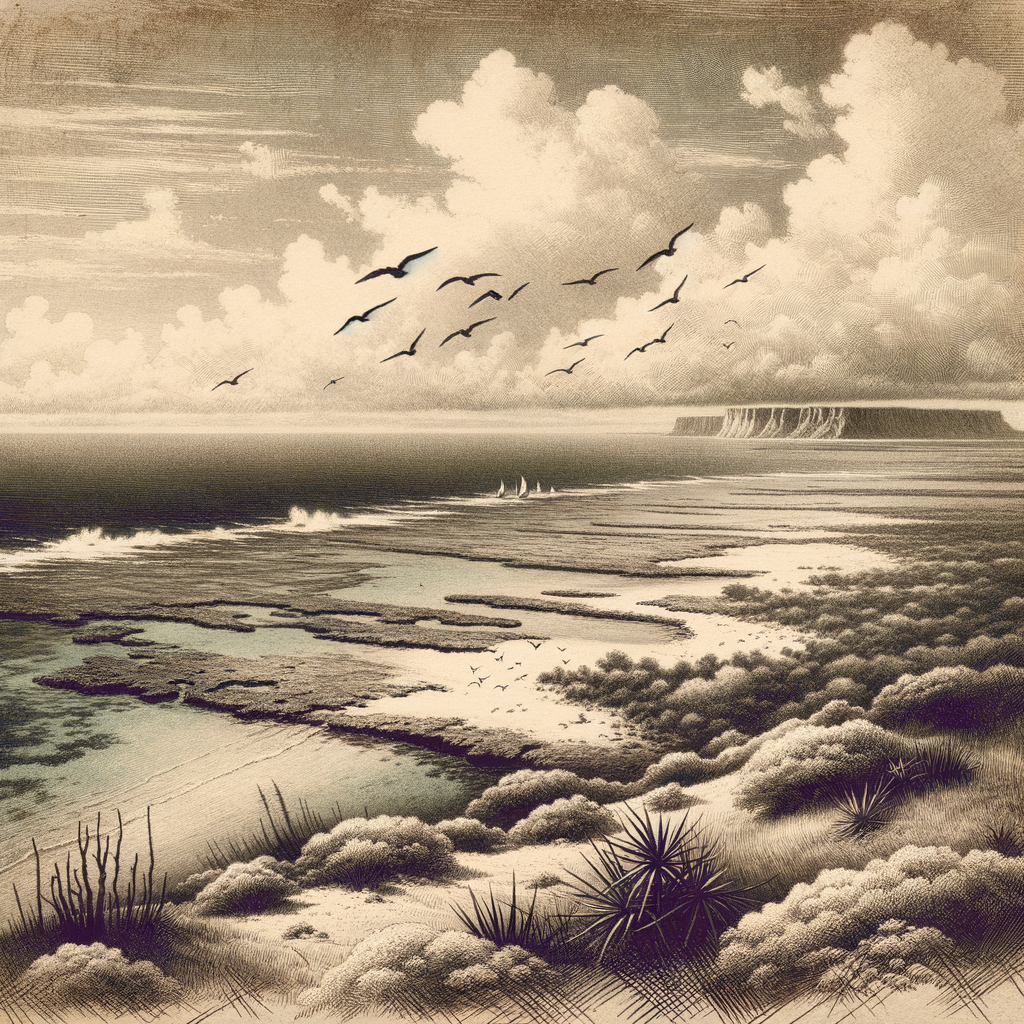
The island is small, roughly three miles long, built of coral limestone and sand, with a narrow fringing reef and no natural anchorage. Rain is erratic. Shade is scarce. The land rises only modestly above sea level, and from a distance it can look less like an island than a pale abrasion on the ocean’s surface. Yet this severity has made it scientifically and ecologically important. Jarvis is part of the Pacific Remote Islands Marine National Monument, and both the land and surrounding waters are protected as National Wildlife Refuge. Isolation, in this case, is not just scenery; it is policy, and a rare kind of preservation.
Guano, empire, and a brief human foothold
Its recorded modern history begins with nineteenth-century sighting and naming by mariners, then quickly turns to extraction. Like several remote equatorial islands, it became valuable because seabirds had done their work for centuries. Guano—bird droppings accumulated in great deposits—was once an agricultural treasure, rich in phosphates and nitrogen, and the United States’ Guano Islands Act of 1856 encouraged claims on such places. Mining followed. Men were put ashore on a land with almost nothing to sustain them, and the enterprise depended on supplies brought from elsewhere. That pattern would define every human attempt here: the island offered strategic use and temporary profit, but never ease.
In the late 1930s the United States established a small settlement as part of the American Equatorial Islands Colonization Project, an effort to maintain a civilian presence on several remote Pacific islands. Young colonists lived in strikingly exposed conditions, building camps, recording weather, and trying to make routine out of blazing heat, limited provisions, and immense solitude. Their stay was cut short by war. After Japan’s attack on Pearl Harbor, the central Pacific changed character overnight; military vulnerability replaced administrative experiment. The colonists were evacuated in 1942. No permanent community returned.
One episode has fixed the island in aviation history. In 1937, during her round-the-world attempt, Amelia Earhart intended to use the U.S. Coast Guard cutter Itasca, stationed off Howland Island to the north, as a radio and navigational aid. Jarvis itself was not her destination, but in the tense geography of that final flight these isolated coral outposts became part of a wider drama of distance, radio uncertainty, and the unforgiving scale of the Pacific. On maps of that story, this island sits nearby like a spare, silent witness.
A seabird province on a dry ring of coral
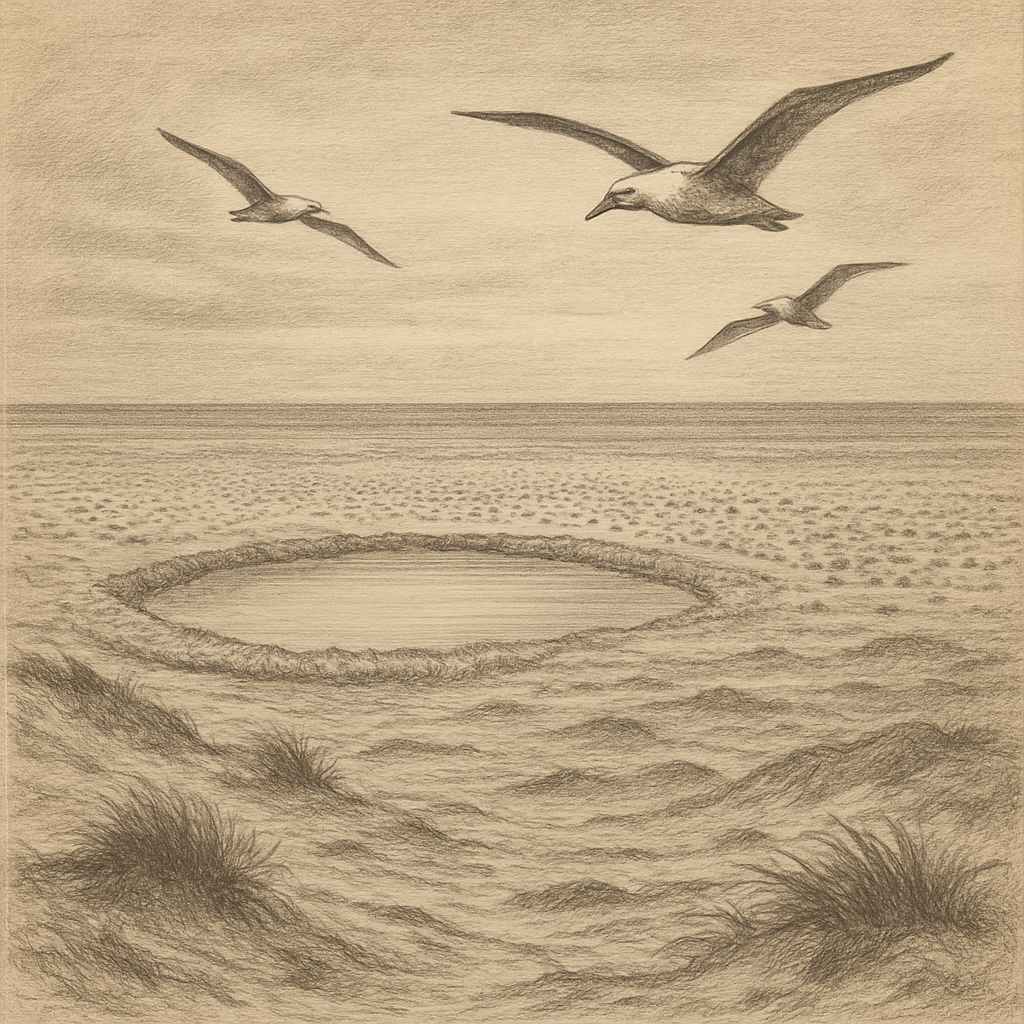
What human beings found inhospitable, seabirds found useful. The island is known as a breeding site for vast numbers of tropical oceanic birds, including sooty terns, brown noddies, and masked boobies. Among the more notable residents is the bristle-thighed curlew, Numenius tahitiensis, a remarkable migratory shorebird that breeds in Alaska and winters on Pacific islands, including this one. Green turtles nest on its beaches. Around the reef, protected waters shelter fish assemblages and predatory species that have become uncommon in more heavily exploited parts of the Pacific.
The terrestrial vegetation is sparse and changeable, shaped by drought, salt, and disturbance. Earlier eras of guano mining and the introduction of nonnative species altered the island’s ecology; in the twentieth century, introduced cats devastated seabird colonies. Their eventual removal was a major conservation milestone, allowing bird populations to recover. On islands this small, ecological balance can swing dramatically from a single human decision. Recovery here is not sentimental; it is measurable in nesting density, in the return of noise to breeding grounds, in the reassertion of old biological rhythms on land that once seemed stripped nearly bare.
The reef and surrounding ocean matter as much as the dry ground. Jarvis lies in an equatorial marine region shaped by powerful climatic oscillations, including El Niño, and scientists value it precisely because it is remote enough to function as a benchmark. Coral communities here have suffered during extreme warming events, but the protected status of the monument has made the waters a crucial site for observing how relatively intact tropical ecosystems respond to stress. Even in damage, the island offers evidence rather than spectacle.
The authority of empty places
There are islands whose appeal lies in abundance, and islands whose pull comes from storybook beauty. This one works differently. Its fascination comes from refusal. It refuses settlement, convenience, romance, and easy scale. Seen in photographs, it can appear almost unfinished: a rim of white and tan, a scatter of scrub, surf striking the edge, seabirds wheeling over a heat-hazed plain. But the longer one looks, the more exacting it becomes. Every feature is sharpened by scarcity. Every trace of human effort seems provisional beside the reef, the sun, and the long recurrence of birds.
That is why the island lingers in the mind. Not as a paradise, and not as a ruin, but as a place where the ocean has nearly erased the usual signs by which people measure importance. What remains is harder and stranger: a defended emptiness, a former outpost now given back to weather, nesting colonies, and the patient work of recovery. In an age when so much of the planet is crowded, named over, and constantly reached, its remoteness feels less like absence than a fact with weight.