A black mass in a vacant quarter of ocean
Ile aux Cochons belongs to the French Southern and Antarctic Lands, yet even in a territory defined by distance it stands apart. The island lies in the Crozet archipelago of the southern Indian Ocean, far from regular sea routes and far from settlement, a steep volcanic body rising from cold water and westerly winds. Its name, “Pig Island,” comes from an old practice common on remote islands: mariners released livestock there as a future food source. What survives in the record, though, is not a story of provisioning but of solitude on a very large scale.
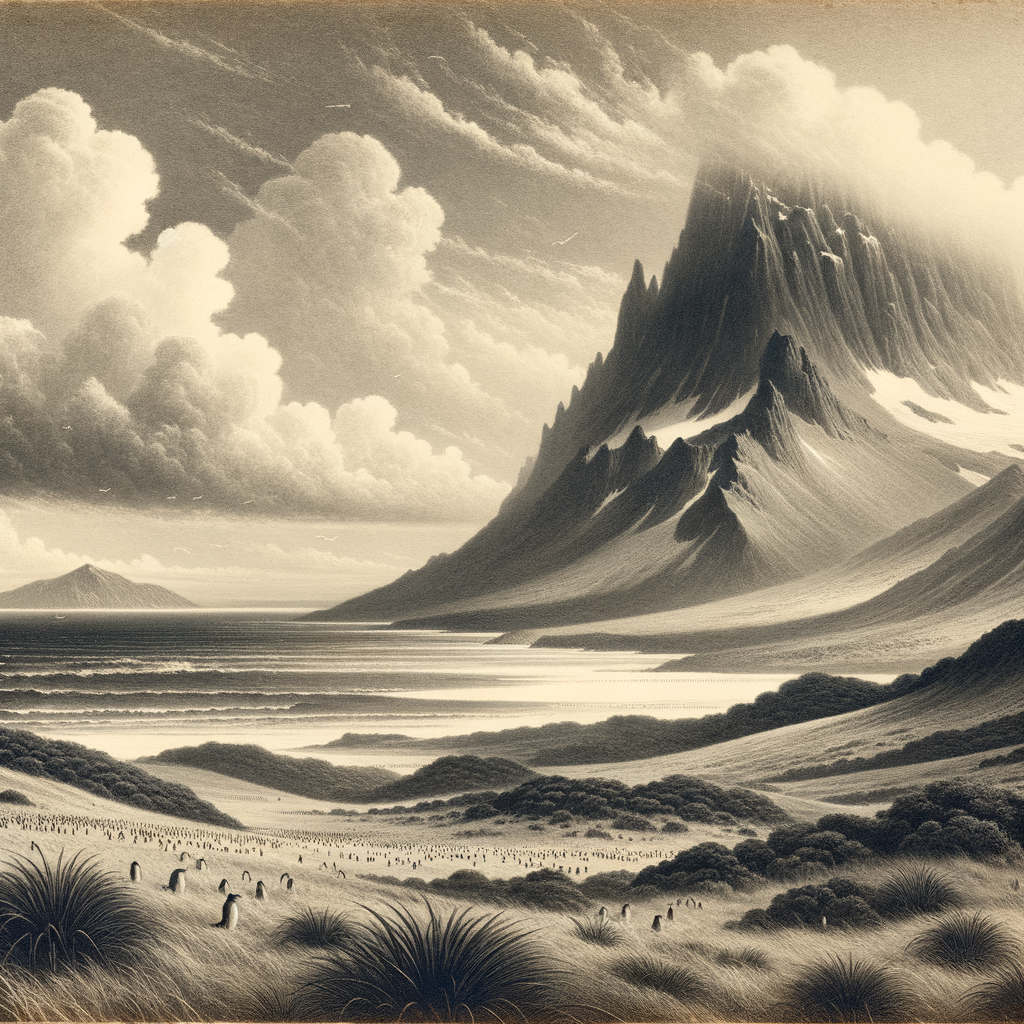
This is not a coral rim or a low sand caye. It is dark, elevated ground, with cliffs, ravines, and a central plateau shaped by volcanic history and battered by a subantarctic climate. Rain, mist, and wind are recurrent facts here; so are rough seas that make landing difficult and infrequent. The Crozets were encountered by French voyages in the 1770s, and the group takes its name from Marc-Joseph Marion du Fresne’s expedition, whose second-in-command Jules Crozet described these islands to Europe. Since then, Ile aux Cochons has remained uninhabited. No permanent station was planted on it, no harbor softened its edge, no settlement endured long enough to alter its basic character.
That absence matters because the island is often understood less through human chronology than through the density of life that gathered there without people. For much of its known history it has been one of the great breeding sites of the southern ocean, a place where seabirds could occupy slopes and open ground in astonishing numbers. Early scientific and logistical visits were brief, often constrained by weather and surf, and that brevity became part of the island’s reality: it was studied in glimpses, then left again to cloud, tussock, and surf.
Where kings once crowded the slopes
The island became especially famous among ornithologists for its king penguins, Aptenodytes patagonicus. A single colony there was long regarded as one of the largest on Earth. Mid-20th-century estimates described a vast concentration, a living expanse of upright birds on dark ground, one of those biological spectacles that seem almost too large for a remote place to hold. Alongside them bred other subantarctic seabirds, including albatrosses and petrels that depend on predator-free islands and broad oceanic feeding grounds.
Yet one of the most arresting modern facts about the island is not abundance but collapse. Comparing historical photographs with satellite imagery and later field observations, researchers found that the great king penguin colony had shrunk dramatically by the early 21st century. A site that had once seemed almost inexhaustible appeared, from above, startlingly diminished. Scientists have investigated possible explanations, including changes in marine food availability linked to climate variability and longer-term shifts in the southern ocean ecosystem. The exact causes remain debated, but the broad fact is clear and well documented: one of the world’s largest king penguin colonies underwent a severe decline.
That transformation gives the island an unusual emotional charge. It is remote enough to feel beyond ordinary human time, yet modern conservation science reaches it through census work, aerial imagery, and comparison across decades. The result is a place that is both hidden and closely watched, not by tourists or residents, but by biologists trying to understand what a distant colony can reveal about the health of the ocean around it.
Brief intrusions, stubborn ground
Human traces on the island are sparse, but the larger history of the Crozets shadows it: sealing in the 19th century, difficult navigation, and the harsh arithmetic of subantarctic landfalls. Across the southern Indian Ocean, islands like this one were known to mariners less as destinations than as hazards, refuges, and points of bearing in bad weather. On Ile aux Cochons itself, the practical obstacles to sustained occupation were formidable. Exposure, isolation, and surf did the work that walls and regulations would do elsewhere.
The old introduction of pigs and other non-native animals to remote islands is part of that maritime era, and the island’s name preserves it with blunt economy. In many subantarctic places such introductions caused severe ecological damage, particularly to ground-nesting birds and native vegetation. The conservation history of the French southern islands has therefore been shaped by the removal or control of invasive species where possible and by strict protection. Today the island falls within a protected framework that recognizes exactly what once made it useful to sailors: its remoteness, and the relative intactness that remoteness can preserve.
There is little folklore attached specifically to the island in the way some wreck-haunted coasts gather stories. Its reputation is instead made of documented conditions: inaccessible shores, a weather system with few favors to offer, and an animal congregation so large that it altered the very appearance of the land. If the place feels uncanny, it is because fact is sufficient. A nameless cloudbank moving over volcanic ridges, a beach difficult to reach, a colony visible from a distance as a pale stain against black earth—none of that needs embellishment.
Seen rarely, counted carefully
What lingers about Ile aux Cochons is the contrast between how little direct human experience it has accumulated and how significant it is scientifically. It is one of those islands known through fragments that are unusually vivid: 18th-century discovery, the durable oddity of its name, the immensity of king penguins, the later shock of decline. The island does not offer a layered civic past or romantic ruins. It offers something starker: a subantarctic landscape in which the main drama has always belonged to weather, breeding cycles, and the changing productivity of the sea.
In photographs, the ground looks severe, almost unfinished, as if wind had stripped every softening gesture away. But the severity is exactly why the place matters. On a remote volcanic island in the Crozets, far south of ordinary itineraries, the fortunes of a penguin colony can become a signal carried outward to the rest of the world. The island remains unpeopled, hard to approach, and easy to miss on any but the broadest map. Even so, it has entered the record with unusual force: not as a stepping-stone or outpost, but as a warning written in birds.